
大学入学共通テスト 2022年(令和4年) 試作問題 数学ⅡBC 第6問 解説
(1)
この問題は先が読みにくいので、深く考えずに問題の流れに沿ってゆこう。

図Aのふたつの赤いベクトルは平行で、大きさが $a:1$ なので、
$\overrightarrow{\mathrm{A_{1}A_{2}}}=a\overrightarrow{\mathrm{B_{1}C_{1}}}$
とかける。
解答ア:a
これは
$$
\begin{align}
\overrightarrow{\mathrm{B_{1}C_{1}}}&=\dfrac{1}{a}\overrightarrow{\mathrm{A_{1}A_{2}}}\\
&=\dfrac{1}{a}\left(\overrightarrow{\mathrm{OA}}_{2}-\overrightarrow{\mathrm{OA_{1}}}\right)\class{tex_formula}{式A}
\end{align}
$$
と変形できる。
同様に、
緑のふたつのベクトルから
$\overrightarrow{\mathrm{A_{2}B_{1}}}=a\overrightarrow{\mathrm{OA_{1}}}$式B
青いふたつのベクトルから
$\overrightarrow{\mathrm{A_{1}C_{1}}}=a\overrightarrow{\mathrm{OA_{2}}}$式C
とかける。

ここで、図Bの
赤いベクトル $=$ 緑のベクトルの和
なので
$$
\begin{align}
\overrightarrow{\mathrm{B_{1}C_{1}}}&=\overrightarrow{\mathrm{B_{1}A_{2}}}+\overrightarrow{\mathrm{A_{2}O}}+\overrightarrow{\mathrm{OA_{1}}}+\overrightarrow{\mathrm{A_{1}C_{1}}}\\
&=-\overrightarrow{\mathrm{A_{2}B_{1}}}-\overrightarrow{\mathrm{OA_{2}}}+\overrightarrow{\mathrm{OA_{1}}}+\overrightarrow{\mathrm{A_{1}C_{1}}}
\end{align}
$$
だけど、これに式B,式Cを代入すると
途中式
$$
\begin{align}
\overrightarrow{\mathrm{B_{1}C_{1}}}&=-a\overrightarrow{\mathrm{OA_{1}}}-\overrightarrow{\mathrm{OA_{2}}}+\overrightarrow{\mathrm{OA_{1}}}+a\overrightarrow{\mathrm{OA_{2}}}\\
&=(a-1)\overrightarrow{\mathrm{OA_{2}}}+(-a+1)\overrightarrow{\mathrm{OA_{1}}}
\end{align}
$$
より
となる。
解答イ:a, ウ:1
これと式Aは同じ$\overrightarrow{\mathrm{B_{1}C_{1}}}$なので、
$\dfrac{1}{a}\left(\overrightarrow{\mathrm{OA}}_{2}-\overrightarrow{\mathrm{OA_{1}}}\right)=(a-1)\left(\overrightarrow{\mathrm{OA_{2}}}-\overrightarrow{\mathrm{OA_{1}}}\right)$
より
$\dfrac{1}{a}=a-1$
と表せる。
これを解くと
途中式
$a^{2}-a-1=0$
$$
\begin{align}
a&=\dfrac{1\pm\sqrt{1-4(-1)}}{2}\\
&=\dfrac{1\pm\sqrt{5}}{2}
\end{align}
$$
$0 \lt a$なので
であることが分かる。
(2)
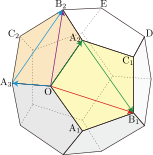
(2)は立体(空間ベクトル)だ。
と言っても、前半は正十二面体のひとつの面上にあるベクトルを考えるから、実質平面ベクトルだけれど。
図Cの黄色い面上で
赤いベクトル $=$ 緑のベクトルの和
なので
$\overrightarrow{\mathrm{OB_{1}}}=\overrightarrow{\mathrm{OA_{2}}}+\overrightarrow{\mathrm{A_{2}B_{1}}}$
だけど、これに式Bを代入すると、
$\overrightarrow{\mathrm{OB_{1}}}=\overrightarrow{\mathrm{OA_{2}}}+a\overrightarrow{\mathrm{OA_{1}}}$式D
同様に、オレンジの面で
紫のベクトル $=$ 青いベクトルの和
より
$\overrightarrow{\mathrm{OB_{2}}}=\overrightarrow{\mathrm{OA_{3}}}+a\overrightarrow{\mathrm{OA_{2}}}$式F
である。
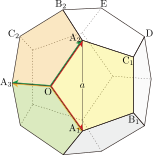
次に、図Dの赤いふたつのベクトルの内積を求める。
$\left|\overrightarrow{\mathrm{A_{1}A_{2}}}\right|=a$
なので
$\overrightarrow{\mathrm{A_{1}A_{2}}}\cdot \overrightarrow{\mathrm{A_{1}A_{2}}}=a^{2}$
だ。
これはさらに
$\left(\overrightarrow{\mathrm{OA_{2}}}-\overrightarrow{\mathrm{OA_{1}}}\right)\cdot \left(\overrightarrow{\mathrm{OA_{2}}}-\overrightarrow{\mathrm{OA_{1}}}\right)=a^{2}$
より
途中式
$\overrightarrow{\mathrm{OA_{2}}}\cdot\overrightarrow{\mathrm{OA_{2}}}-2\overrightarrow{\mathrm{OA_{1}}}\cdot\overrightarrow{\mathrm{OA_{2}}}+\overrightarrow{\mathrm{OA_{1}}}\cdot\overrightarrow{\mathrm{OA_{1}}}=a^{2}$
$\left|\overrightarrow{\mathrm{OA_{2}}}\right|^{2}-2\overrightarrow{\mathrm{OA_{1}}}\cdot\overrightarrow{\mathrm{OA_{2}}}+\left|\overrightarrow{\mathrm{OA_{1}}}\right|^{2}=a^{2}$
$1-2\overrightarrow{\mathrm{OA_{1}}}\cdot\overrightarrow{\mathrm{OA_{2}}}+1=a^{2}$
$2\overrightarrow{\mathrm{OA_{1}}}\cdot\overrightarrow{\mathrm{OA_{2}}}=2-a^{2}$
と変形できる。
これに$a$の値を代入すると、
$\overrightarrow{\mathrm{OA_{1}}}\cdot\overrightarrow{\mathrm{OA_{2}}}=1-\dfrac{1}{2}\left(\dfrac{1+\sqrt{5}}{2}\right)^{2}$
途中式
$$
\begin{align}
\phantom{\overrightarrow{\mathrm{OA_{1}}}\cdot\overrightarrow{\mathrm{OA_{2}}}}&=1-\dfrac{1}{2}\cdot\dfrac{1+2\sqrt{5}+5}{4}\\
&=1-\dfrac{1}{2}\cdot\dfrac{6+2\sqrt{5}}{4}\\
&=\dfrac{4}{4}-\dfrac{3+\sqrt{5}}{4}\\
\end{align}
$$
であることが分かる。
解答エ:1, オ:5, カ:4
別解
$\overrightarrow{\mathrm{OA_{1}}}\cdot\overrightarrow{\mathrm{OA_{2}}}$は次のようにしても求められる。
$$ \begin{align} \overrightarrow{\mathrm{OA_{1}}}\cdot\overrightarrow{\mathrm{OA_{2}}}&=\left|\overrightarrow{\mathrm{OA_{1}}}\right|\left|\overrightarrow{\mathrm{OA_{2}}}\right|\cos\angle \mathrm{A_{1}OA_{2}}\\ &=1\cdot1\cdot\cos\angle \mathrm{A_{1}OA_{2}}\class{tex_formula}{式E} \end{align} $$
ここで、$\triangle \mathrm{OA_{1}A_{2}}$に余弦定理を使って、
$$
\begin{align}
\mathrm{A_{1}A_{2}}^{2}=&\mathrm{OA_{1}}^{2}+\mathrm{OA_{2}}^{2}\\
&\quad -2\mathrm{OA_{1}}\cdot \mathrm{OA_{2}}\cos\angle \mathrm{A_{1}OA_{2}}
\end{align}
$$
これにそれぞれの値を代入すると、
途中式
$$
\begin{align}
\left(\dfrac{1+\sqrt{5}}{2}\right)^{2}&=1^{2}+1^{2}-2\cdot 1\cdot 1\cos\angle \mathrm{A_{1}OA_{2}}\\
&=2-2\cos\angle \mathrm{A_{1}OA_{2}}
\end{align}
$$
両辺を$4$倍して
$(1+\sqrt{5})^{2}=8-8\cos\angle \mathrm{A_{1}OA_{2}}$
$$
\begin{align}
8\cos\angle \mathrm{A_{1}OA_{2}}&=8-(1+\sqrt{5})^{2}\\
&=8-1-2\sqrt{5}-5\\
&=2-2\sqrt{5}
\end{align}
$$
となる。
よって、式Eより
$\overrightarrow{\mathrm{OA_{1}}}\cdot\overrightarrow{\mathrm{OA_{2}}}=\dfrac{1-\sqrt{5}}{4}$
であることが分かる。
解答エ:1, オ:5, カ:4
図Dの正十二面体は、
すべての辺が等しい
すべての面のすべての角が等しい
から、ひとつの頂点から 異なるふたつの隣の頂点へのベクトルの内積はすべて等しい。
したがって、図Dの
ふたつの赤いベクトルの内積
ふたつの緑のベクトルの内積
ふたつのオレンジのベクトルの内積
はすべて等しい。
なので、
$$
\begin{align}
\overrightarrow{\mathrm{OA_{1}}}\cdot&\overrightarrow{\mathrm{OA_{2}}}=\overrightarrow{\mathrm{OA_{2}}}\cdot\overrightarrow{\mathrm{OA_{3}}}\\
&=\overrightarrow{\mathrm{OA_{3}}}\cdot\overrightarrow{\mathrm{OA_{1}}}=\dfrac{1-\sqrt{5}}{4}
\end{align}
$$
である。
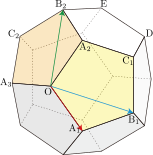
だんだん空間ベクトルらしい問題になってきた。
図Eの赤と緑のベクトルの内積
$\overrightarrow{\mathrm{OA_{1}}}\cdot\overrightarrow{\mathrm{OB_{2}}}$
を求める。
これは、式Fより
$$
\begin{align}
\overrightarrow{\mathrm{OA_{1}}}\cdot\overrightarrow{\mathrm{OB_{2}}}&=\overrightarrow{\mathrm{OA_{1}}}\cdot\left(\overrightarrow{\mathrm{OA_{3}}}+a\overrightarrow{\mathrm{OA_{2}}}\right)\\
&=\overrightarrow{\mathrm{OA_{1}}}\cdot\overrightarrow{\mathrm{OA_{3}}}+a\overrightarrow{\mathrm{OA_{1}}}\cdot\overrightarrow{\mathrm{OA_{1}}}
\end{align}
$$
と変形できる。
これにそれぞれの値を代入すると、
$\overrightarrow{\mathrm{OA_{1}}}\cdot\overrightarrow{\mathrm{OB_{2}}}=\dfrac{1-\sqrt{5}}{4}+\dfrac{1+\sqrt{5}}{2}\cdot\dfrac{1-\sqrt{5}}{4}$
途中式
$$
\begin{align}
\phantom{\overrightarrow{\mathrm{OA_{1}}}\cdot\overrightarrow{\mathrm{OB_{2}}}}&=\dfrac{1-\sqrt{5}}{4}\left(1+\dfrac{1+\sqrt{5}}{2}\right)\\
&=\dfrac{1-\sqrt{5}}{4}\cdot\dfrac{3+\sqrt{5}}{2}\\
&=\dfrac{3+\sqrt{5}-3\sqrt{5}-5}{4\cdot 2}\\
&=\dfrac{-2-2\sqrt{5}}{4\cdot 2}
\end{align}
$$
となる。
解答キ:9
また、青と緑のベクトルの内積は、式Dより
$$
\begin{align}
\overrightarrow{\mathrm{OB_{1}}}\cdot\overrightarrow{\mathrm{OB_{2}}}&=\left(\overrightarrow{\mathrm{OA_{2}}}+a\overrightarrow{\mathrm{OA_{1}}}\right)\cdot\overrightarrow{\mathrm{OB_{2}}}\\
&=\overrightarrow{\mathrm{OA_{2}}}\cdot\overrightarrow{\mathrm{OB_{2}}}+a\overrightarrow{\mathrm{OA_{1}}}\cdot\overrightarrow{\mathrm{OB_{2}}}
\end{align}
$$
とかける。
これに式Fを代入して、
$\overrightarrow{\mathrm{OB_{1}}}\cdot\overrightarrow{\mathrm{OB_{2}}}$
途中式
$$
\begin{align}
&\quad=\overrightarrow{\mathrm{OA_{2}}}\cdot\left(\overrightarrow{\mathrm{OA_{3}}}+a\overrightarrow{\mathrm{OA_{2}}}\right)+a\overrightarrow{\mathrm{OA_{1}}}\cdot\overrightarrow{\mathrm{OB_{2}}}\\
&\quad=\overrightarrow{\mathrm{OA_{2}}}\cdot\overrightarrow{\mathrm{OA_{3}}}+a\left|\overrightarrow{\mathrm{OA_{2}}}\right|^{2}+a\overrightarrow{\mathrm{OA_{1}}}\cdot\overrightarrow{\mathrm{OB_{2}}}\\
\end{align}
$$
これにそれぞれの値を代入すると
途中式
$$
\begin{align}
&\overrightarrow{\mathrm{OB_{1}}}\cdot\overrightarrow{\mathrm{OB_{2}}}\\
&\qquad=\dfrac{1-\sqrt{5}}{4}+\dfrac{1+\sqrt{5}}{2}\left(1+\dfrac{-1-\sqrt{5}}{4}\right)\\
&\qquad=\dfrac{1-\sqrt{5}}{4}+\dfrac{1+\sqrt{5}}{2}\cdot\dfrac{3-\sqrt{5}}{4}\\
&\qquad=\dfrac{1-\sqrt{5}}{4}+\dfrac{3-\sqrt{5}+3\sqrt{5}-5}{2\cdot 4}\\
&\qquad=\dfrac{1-\sqrt{5}}{4}+\dfrac{-2+2\sqrt{5}}{2\cdot 4}\\
&\qquad=\dfrac{1-\sqrt{5}}{4}+\dfrac{-1+\sqrt{5}}{4}
\end{align}
$$
なので、
となる。
解答ク:0
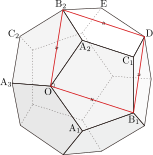
最後に、図Fの赤い四角形を考える。
これまでの作業で、
赤い四角形のすべての辺の長さは等しい
クより 内積が $0$ なので、$\angle \mathrm{B_{1}OB_{2}}=90^{\circ}$
であることが分かっている。
したがって、赤い四角形は
正方形
である。
解答ケ:0