
大学入試センター試験 2020年(令和2年) 本試 数学ⅡB 第4問 解説
問題を解く準備
まず、図を描く。
座標をとって描くと図Aみたいなのができるけど、時間がかかるのでお勧めしない。
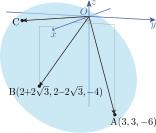
問題文を読むと、点$\mathrm{O}$,$\mathrm{A}$,$\mathrm{B}$,$\mathrm{C}$はすべて平面α上にある。
なので、図Bのような平面αだけの図を描こう。
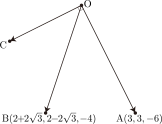
点$\mathrm{C}$は点$\mathrm{O}$の右側ってことも考えられるけど、そうすると$\angle \mathrm{BOC}$は鈍角になる。
$\cos\angle \mathrm{BOC}$は負になるから、$\overrightarrow{\mathrm{OB}}\cdot\overrightarrow{\mathrm{OC}}$も負になる。
なので、これは不適だ。
それから、どうせ問題を解いてゆくと立体の図が必要になるんだろうけど、それはその時考えることにする。
(1)
$\overrightarrow{\mathrm{OA}}=(3,3,-6)$
より、
$$
\begin{align}
\left|\overrightarrow{\mathrm{OA}}\right|&=\sqrt{3^{2}+3^{2}+(-6)^{2}}\\
&=\sqrt{3^{2}(1+1+2^{2})}\\
&=3\sqrt{6}\class{tex_formula}{式A}
\end{align}
$$
である。
解答ア:3, イ:6
$\overrightarrow{\mathrm{OB}}=(2+2\sqrt{3},2-2\sqrt{3},-4)$
より、
$\left|\overrightarrow{\mathrm{OB}}\right|=\sqrt{(2+2\sqrt{3})^{2}+(2-2\sqrt{3})^{2}+(-4)^{2}}$
途中式
$$
\begin{align}
\phantom{\left|\overrightarrow{\mathrm{OB}}\right|}&=\sqrt{2^{2}(1+\sqrt{3})^{2}+2^{2}(1-\sqrt{3})^{2}+4^{2}}\\
&=\sqrt{2^{2}(1+2\sqrt{3}+3+1-2\sqrt{3}+3+4)}\\
&=\sqrt{2^{2}\cdot 4\cdot 3}
\end{align}
$$
である。
解答ウ:4, エ:3
また、$\overrightarrow{\mathrm{OA}}\cdot\overrightarrow{\mathrm{OB}}$は、両方のベクトルの成分より、
$$
\begin{align}
\overrightarrow{\mathrm{OA}}\cdot\overrightarrow{\mathrm{OB}}&=3(2+2\sqrt{3})\\
&\qquad +3(2-2\sqrt{3})+(-6)(-4)
\end{align}
$$
途中式
$$
\begin{align}
\phantom{\overrightarrow{\mathrm{OA}}\cdot\overrightarrow{\mathrm{OB}}}&=3\cdot2(1+\sqrt{3}+1-\sqrt{3}+4)\\
&=3\cdot 2 \cdot 6
\end{align}
$$
となる。
解答オ:3, カ:6
(2)
$\overrightarrow{\mathrm{OC}}=s\overrightarrow{\mathrm{OA}}+t\overrightarrow{\mathrm{OB}}$式D
とおく。
①より$\overrightarrow{\mathrm{OA}}$⊥$\overrightarrow{\mathrm{OC}}$なので、
$\overrightarrow{\mathrm{OA}}\cdot\overrightarrow{\mathrm{OC}}=0$
とかける。
これに式Dを代入して、
$\overrightarrow{\mathrm{OA}}\cdot\left(s\overrightarrow{\mathrm{OA}}+t\overrightarrow{\mathrm{OB}}\right)=0$
より
$s\overrightarrow{\mathrm{OA}}\cdot\overrightarrow{\mathrm{OA}}+t\overrightarrow{\mathrm{OA}}\cdot\overrightarrow{\mathrm{OB}}=0$
$s\left|\overrightarrow{\mathrm{OA}}\right|^{2}+t\overrightarrow{\mathrm{OA}}\cdot\overrightarrow{\mathrm{OB}}=0$
となる。
これに式A,式Cを代入して、
$\left(3\sqrt{6}\right)^{2}s+36t=0$
$9\cdot 6s+36t=0$
$3s+2t=0$式E
と表せる。
また、①の
$\overrightarrow{\mathrm{OB}}\cdot\overrightarrow{\mathrm{OC}}=24$
に式Dを代入して、
$\overrightarrow{\mathrm{OB}}\cdot\left(s\overrightarrow{\mathrm{OA}}+t\overrightarrow{\mathrm{OB}}\right)=24$
とかける。
これを計算して、
$s\overrightarrow{\mathrm{OB}}\cdot\overrightarrow{\mathrm{OA}}+t\overrightarrow{\mathrm{OB}}\cdot\overrightarrow{\mathrm{OB}}=24$
より
$s\overrightarrow{\mathrm{OA}}\cdot\overrightarrow{\mathrm{OB}}+t\left|\overrightarrow{\mathrm{OB}}\right|^{2}=24$
と表せる。
これに式B,式Cを代入して、
$36s+\left(4\sqrt{3}\right)^{2}t=24$
$36s+4^{2}\cdot 3t=24$
両辺を$12$で割って、
$3s+4t=2$式F
である。
この式E,式Fを連立方程式として解く。
式F-式Eより、
| $3s$ | $+4t$ | $=$ | $2$ | |
| $-)$ | $3s$ | $+2t$ | $=$ | $0$ |
| $2t$ | $=$ | $2$ |
なので、
$t=1$
これを式Eに代入して、
$3s+2=0$
$s=-\displaystyle \frac{2}{3}$
となる。
解答キ:-, ク:2, ケ:3, コ:1
$s=-\displaystyle \frac{2}{3}$,$t=1$を式Dに代入して、
$\displaystyle \overrightarrow{\mathrm{OC}}=-\frac{2}{3}\overrightarrow{\mathrm{OA}}+\overrightarrow{\mathrm{OB}}$式G
より
$\displaystyle \overrightarrow{\mathrm{OC}}=-\frac{2}{3}(3,3,-6)+(2+2\sqrt{3},2-2\sqrt{3},-4)$
とかける。
これを計算して、
$$
\begin{align}
\overrightarrow{\mathrm{OC}}&=(-2,-2,4)+(2+2\sqrt{3},2-2\sqrt{3},-4)\\
&=(2\sqrt{3},-2\sqrt{3},0)\class{tex_formula}{式H}
\end{align}
$$
である。
よって、$\left|\overrightarrow{\mathrm{OC}}\right|$は、
$$
\begin{align}
\left|\overrightarrow{\mathrm{OC}}\right|&=\sqrt{(2\sqrt{3})^{2}+(-2\sqrt{3})^{2}+0^{2}}\\
&=\sqrt{(2\sqrt{3})^{2} \cdot 2}\\
&=2\sqrt{3}\cdot\sqrt{2}\\
&=2\sqrt{6}
\end{align}
$$
である。
解答サ:2, シ:6
別解
$s=-\dfrac{2}{3}$,$t=1$を式Dに代入して、
$\overrightarrow{\mathrm{OC}}=-\dfrac{2}{3}\overrightarrow{\mathrm{OA}}+\overrightarrow{\mathrm{OB}}$式G
より
$\left|\overrightarrow{\mathrm{OC}}\right|^{2}=\left|-\dfrac{2}{3}\overrightarrow{\mathrm{OA}}+\overrightarrow{\mathrm{OB}}\right|^{2}$
なので、
$$
\begin{align}
\left|\overrightarrow{\mathrm{OC}}\right|^{2}&=\left(-\frac{2}{3}\overrightarrow{\mathrm{OA}}+\overrightarrow{\mathrm{OB}}\right)\cdot\left(-\frac{2}{3}\overrightarrow{\mathrm{OA}}+\overrightarrow{\mathrm{OB}}\right)\\
&=\left(\frac{2}{3}\right)^{2}\left|\overrightarrow{\mathrm{OA}}\right|^{2}-2\cdot\frac{2}{3}\overrightarrow{\mathrm{OA}}\cdot\overrightarrow{\mathrm{OB}}+\left|\overrightarrow{\mathrm{OB}}\right|^{2}
\end{align}
$$
これに式A,式B,式Cを代入して、
$\left|\overrightarrow{\mathrm{OC}}\right|^{2}=\left(\dfrac{2}{3}\right)^{2}\left(3\sqrt{6}\right)^{2}-2\cdot\dfrac{2}{3}\cdot 36+\left(4\sqrt{3}\right)^{2}$
途中式
$$
\begin{align}
\phantom{\left|\overrightarrow{\mathrm{OC}}\right|^{2}}&=\left(\frac{2}{3}\cdot 3\sqrt{6}\right)^{2}-2\cdot\frac{2}{3}\cdot 36+\left(4\sqrt{3}\right)^{2}\\
&=\left(2\sqrt{6}\right)^{2}-2\cdot 2\cdot 12+\left(4\sqrt{3}\right)^{2}\\
&=2^{2}\left(6-12+12\right)
\end{align}
$$
となるから、
$\left|\overrightarrow{\mathrm{OC}}\right|=2\sqrt{6}$
である。
解答サ:2, シ:6
(3)
$\overrightarrow{\mathrm{CB}}=\overrightarrow{\mathrm{OB}}-\overrightarrow{\mathrm{OC}}$
とかける。
これに式Gを代入して、
$\displaystyle \overrightarrow{\mathrm{CB}}=\overrightarrow{\mathrm{OB}}-\left(-\frac{2}{3}\overrightarrow{\mathrm{OA}}+\overrightarrow{\mathrm{OB}}\right)$
より
$\displaystyle \overrightarrow{\mathrm{CB}}=\overrightarrow{\mathrm{OB}}+\frac{2}{3}\overrightarrow{\mathrm{OA}}-\overrightarrow{\mathrm{OB}}$
$\displaystyle \overrightarrow{\mathrm{CB}}=\frac{2}{3}\overrightarrow{\mathrm{OA}}$式I
であることが分かる。
いま、
$\overrightarrow{\mathrm{OA}}=(3,3,-6)$
なので、式Iは
$\displaystyle \overrightarrow{\mathrm{CB}}=\frac{2}{3}(3,3,-6)$
とかける。
これを計算して、
$\overrightarrow{\mathrm{CB}}=(2,2,-4)$
である。
解答ス:2, セ:2, ソ:-, タ:4
ここで、ベクトルの平行について復習しておく。
復習
2つの$\vec{0}$でないベクトル$\vec{a}$,$\vec{b}$について、$k$を$0$でない実数として、
$\vec{a} \HEIKOU \vec{b}$ $\Leftrightarrow$ $\vec{a}=k\vec{b}$
である。
式Iより
$\displaystyle \overrightarrow{\mathrm{CB}}=\frac{2}{3}\overrightarrow{\mathrm{OA}}$
だった。
なので、復習より
$\overrightarrow{\mathrm{CB}} \HEIKOU \overrightarrow{\mathrm{OA}}$
であることが分かる。
また、
$\left|\overrightarrow{\mathrm{CB}}\right|\neq\left|\overrightarrow{\mathrm{OA}}\right|$
である。
よって、四角形$\mathrm{OABC}$について、
$\mathrm{OA} \HEIKOU \mathrm{CB}$
なので台形だけど、
$\mathrm{OA}\neq \mathrm{CB}$
なので平行四辺形ではない。
以上より、正しい選択肢は
③
である。
解答チ:3
別解
上の解説は計算だけで解いたけど、図で考えると次のようになる。
やっていることは同じだけれど。
式Gを
$\textcolor{royalblue}{\overrightarrow{\mathrm{OC}}}=\textcolor{red}{\overrightarrow{\mathrm{OB}}-\dfrac{2}{3}\overrightarrow{\mathrm{OA}}}$式G'
と変形して図にすると、図Cのようになる。
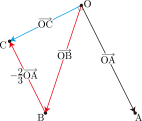
式G'の左辺が図Cの青いベクトル、右辺が赤いベクトルだ。
図Cより、
$\displaystyle \overrightarrow{\mathrm{BC}}=-\frac{2}{3}\overrightarrow{\mathrm{OA}}$
なので
$\displaystyle \overrightarrow{\mathrm{CB}}=\frac{2}{3}\overrightarrow{\mathrm{OA}}$式I
だから、
$\mathrm{OA} \HEIKOU \mathrm{CB}$
$\mathrm{OA}\neq \mathrm{CB}$
であることが分かる。
いま、
$\overrightarrow{\mathrm{OA}}=(3,3,-6)$
なので、式Iは
$\displaystyle \overrightarrow{\mathrm{CB}}=\frac{2}{3}(3,3,-6)$
とかける。
これを計算して、
$\overrightarrow{\mathrm{CB}}=(2,2,-4)$
である。
解答ス:2, セ:2, ソ:-, タ:4
$\mathrm{OA} \HEIKOU \mathrm{CB}$,$\mathrm{OA}\neq \mathrm{CB}$より、四角形$\mathrm{OABC}$は
台形だけど
平行四辺形ではない
よって、正しい選択肢は
③
である。
解答チ:3
ここまでに分かったことを図Bに書き込むと、図Dができる。
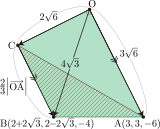
台形の面積は
$\displaystyle \frac{1}{2}\times($上底$+$下底$)\times$高さ
なので、図Dより、四角形$\mathrm{OABC}$(緑の台形)の面積$S$は、
$$
\begin{align}
S&=\frac{1}{2}\left(\frac{2}{3}\cdot 3\sqrt{6}+3\sqrt{6}\right)\cdot 2\sqrt{6}\\
&=\frac{1}{2}\left(\frac{2}{3}\cdot 3 +3\right)\cdot \sqrt{6}\cdot 2\sqrt{6}\\
&=\frac{1}{2}\cdot 5\cdot 2\cdot 6\\
&=30
\end{align}
$$
である。
解答ツ:3, テ:0
それから、どうせ先で使うので、△$\mathrm{ABC}$(図Dの斜線の三角形)の面積も求めておこう。
$\mathrm{BC}$⊥$\mathrm{OC}$なので、$\mathrm{BC}$を底面とすると、△$\mathrm{ABC}$の高さは
$\mathrm{OC}=2\sqrt{6}$
である。
よって、△$\mathrm{ABC}$の面積は、
△$\displaystyle \mathrm{ABC}=\frac{1}{2}\times$底辺$\times$高さ
$$
\begin{align}
\hspace{53px}&=\frac{1}{2} \cdot \mathrm{BC}\cdot \mathrm{OC}\\
&=\frac{1}{2}\cdot \frac{2}{3}\cdot 3\sqrt{6}\cdot 2\sqrt{6}\\
&=2\cdot \sqrt{6}\cdot \sqrt{6}\\
&=12\class{tex_formula}{式J}
\end{align}
$$
である。
(4)
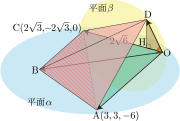
やっぱり立体の問題になった。
なので、仕方がないから立体の図を描くと、図Eのようになる。
点$\mathrm{D}$の座標($\overrightarrow{\mathrm{OD}}$の成分)を
$(x,y,1)$式K
とおく。
$\overrightarrow{\mathrm{OA}}$⊥$\overrightarrow{\mathrm{OD}}$なので、
$(3,3,-6)\cdot(x,y,1)=0$
より
$3x+3y-6=0$
$x+y=2$式L
となる。
また、$\overrightarrow{\mathrm{OC}}\cdot\overrightarrow{\mathrm{OD}}=2\sqrt{6}$に式Hと式Kを代入して、
$(2\sqrt{3},-2\sqrt{3},0)\cdot(x,y,1)=2\sqrt{6}$
より
$2\sqrt{3}x-2\sqrt{3}y=2\sqrt{6}$
$x-y=\sqrt{2}$式M
である。
この式L,式Mを連立方程式として解く。
式L$+$式Mより、
| $x$ | $+y$ | $=$ | $2$ | |
| $+)$ | $x$ | $-y$ | $=$ | $\sqrt{2}$ |
| $2x$ | $=$ | $2+\sqrt{2}$ |
なので、
$$
\begin{align}
x&=\frac{2+\sqrt{2}}{2}\\
&=1+\frac{\sqrt{2}}{2}
\end{align}
$$
となる。
また、式L-式Mより、
| $x$ | $+y$ | $=$ | $2$ | |
| $-)$ | $x$ | $-y$ | $=$ | $\sqrt{2}$ |
| $2y$ | $=$ | $2-\sqrt{2}$ |
なので、
$$
\begin{align}
y&=\frac{2-\sqrt{2}}{2}\\
&=1-\frac{\sqrt{2}}{2}
\end{align}
$$
である。
よって、点$\mathrm{D}$の座標($\overrightarrow{\mathrm{OD}}$の成分)は
$\displaystyle \left(1+\frac{\sqrt{2}}{2},1-\frac{\sqrt{2}}{2},1\right)$
となる。
解答ト:1, ナ:2, ニ:2, ヌ:1, ネ:2, ノ:2
このとき、$\left|\overrightarrow{\mathrm{OD}}\right|$は、
$\left|\overrightarrow{\mathrm{OD}}\right|=\sqrt{\left(1+\dfrac{\sqrt{2}}{2}\right)^{2}+\left(1-\dfrac{\sqrt{2}}{2}\right)^{2}+1^{2}}$
途中式
$$
\begin{align}
\phantom{\left|\overrightarrow{\mathrm{OD}}\right|}&=\sqrt{1+\sqrt{2}+\frac{2}{4}+1-\sqrt{2}+\frac{2}{4}+1}\\
&=\sqrt{4}
\end{align}
$$
となる。
よって、$\overrightarrow{\mathrm{OC}}\cdot\overrightarrow{\mathrm{OD}}=2\sqrt{6}$は、$\angle \mathrm{COD}$(図Eのオレンジの角)を使って、
$\left|\overrightarrow{\mathrm{OC}}\right|\cdot\left|\overrightarrow{\mathrm{OD}}\right|\cos\angle \mathrm{COD}=2\sqrt{6}$
より
$2\sqrt{6}\cdot 2\cos\angle \mathrm{COD}=2\sqrt{6}$
$\displaystyle \cos\angle \mathrm{COD}=\frac{1}{2}$
であることが分かる。
いま、$0^{\circ} \lt \angle \mathrm{COD} \lt 180^{\circ}$なので、
$\angle \mathrm{COD}=60^{\circ}$
である。
解答ハ:6, ヒ:0
図Eのように、点$\mathrm{D}$から$\mathrm{OC}$に垂線をおろした垂線の足を点$\mathrm{H}$とする。
このとき、△$\mathrm{ODH}$(茶色い三角形)は、
式Nより、$\mathrm{OD}=2$
ハヒより、オレンジの角は$60^{\circ}$
なので、各辺が$1$,$2$,$\sqrt{3}$の直角三角形だ。
よって、
$\mathrm{DH}=\sqrt{3}$
である。
また、
$\overrightarrow{\mathrm{DH}}$⊥平面$\alpha$
だ。
詳しく
ここで、ベクトルと平面の垂直について復習をしておこう。
復習
$\vec{p}$,$\vec{q}$が平面$\alpha$上にある平行でなく$\vec{0}$でもないベクトルとして、
平面$\alpha$とベクトル$\vec{a}$が垂直
$\Updownarrow$
$\vec{a}$⊥$\vec{p}$ かつ $\vec{a}$⊥$\vec{q}$
である。
復習より、$\overrightarrow{\mathrm{OA}}$⊥$\overrightarrow{\mathrm{OC}}$ かつ $\overrightarrow{\mathrm{OA}}$⊥$\overrightarrow{\mathrm{OD}}$なので、$\overrightarrow{\mathrm{OA}}$と平面$\beta$は垂直。
よって、平面$\beta$上にある$\vec{0}$でないベクトルはすべて、$\overrightarrow{\mathrm{OA}}$と垂直である。
さらに、
$\overrightarrow{\mathrm{DH}}$⊥$\overrightarrow{\mathrm{OC}}$
で、$\overrightarrow{\mathrm{OC}}$は平面$\alpha$上のベクトルだ。
なので、$\overrightarrow{\mathrm{DH}}$は、平面$\alpha$上にある平行でも$\vec{0}$でもない2つのベクトルの$\overrightarrow{\mathrm{OA}}$および$\overrightarrow{\mathrm{OC}}$と垂直である。
よって、$\overrightarrow{\mathrm{DH}}$は平面$\alpha$と垂直である。
よって、△$\mathrm{ABC}$を底面とする四面体$\mathrm{DABC}$(図Eのピンクの四面体)の高さは$\mathrm{DH}$で、
$\sqrt{3}$
である。
解答フ:3
もうちょっとだ。
四面体の底面(図Eの斜線の三角形)の面積は、式Jより
$12$
フより、四面体の高さは
$\sqrt{3}$
なので、四面体の体積$V$は、
$ V=\displaystyle \frac{1}{3}\times$底面積$\times$高さ
より
$$
\begin{align}
V&=\frac{1}{3}\cdot 12\cdot\sqrt{3}\\
&=4\sqrt{3}
\end{align}
$$
となる。
解答ヘ:4, ホ:3